Pete's Place

IronButt Association rides, reports, and product evaluations.

Thursday, April 9, 2015

Fitting a Garmin nuvi 2797 to a Motorcycle

I've been running Garmin GPS's on my motorcycles since 2001. The best one I ever had was the Garmin 2610. It had lots of configurable features. They've gone downhill since then. I completely understand a business catering more to the larger market but it is frustrating.

There has been a lot of discussion in my community about Garmin's nĂ¼vi® 2797LMT. Considering the size and features, Garmin's $270 is a bargain and street prices are $40 less. When you compare this to Garmin's Zumo line for motorcycles, with prices from $600 to $900, taking the chance of putting this on a motorcycle is highly tempting.

Based on Greg Rice's article on his experiences with I purchased one used from a friend. [Greg's write up of the unit's features and screenshots is excellent which I'll not reproduce] The unit I purchased came with the Ram mounting so I was quite pleased with my $185 price, I mounted it up and have been playing with it without having it wired to my audio system.

Since I'm tooling up for the 2015 Iron Butt Rally™ I needed to get the audio connected to my bike. With that done, I am mightily impressed with my short test run. I never thought having voice actuation would be an important feature but, based on my initial testing, it looks like it's going to be a winner. Of course, a giant display is nothing to scoff at.

Here you can see it mounted on the left side of my dash shelf.

Note the sunshade. I had a shade like this on my K1200LT with the Touratech locking mount and really missed having it. Not so much for the shade, but for having a place to stick my pens. I LOVE velcro.

Here is how I implemented the audio changes.

I followed Greg's procedure with only one problem with removing the back of the unit. After you remove the screws (one of these kits from Harbor Freight is essential for working on miniature electronics), the back didn't come off. Turns out there are little tabs around the periphery that need to be disengaged. This requires prying the edges up, always a concerning task since the the tabs break easily. Some type of spudger tool is preferable to a screwdriver or knife which can mar the case.

I'm posting my pictures, not because Greg's are deficient in any manner but because my job was a little cleaner. In all fairness I was trained as an aerospace electronics assembly technician in a previous life.

This is the before I messed it up shot.
Rather than cut the speaker wires I removed the rubber coating and unsoldered the wires.
The microphone wires needed to be cut. Ends are tinned ready for splice. Mic pigtail is taped down to inside of case. I drilled two holes for the audio wire and put rubber grommets in place.
Splices have been made, shrink wrapped, and taped to the case. Zip ties are to prevent wires from being easily pulled out.
I almost forgot to label which wire was which. [FWIW one of these printers is really nice to  have around.]
Some RTV sealant to resist water intrusion.
Taped over non-essential openings (speaker grill and SD card slot) to minimize the risk of water intrusion.

Tuesday, March 31, 2015

Rally Preparation (Pelican/Storm Case Lid Organizer)

I've finally caught up on my work and have started fixing my bike up for the rally season. There are several items I've done. This will be the first post of several more.

I got this idea from one of my customers and decided to implement it.

This is a lid organizer for a Pelican/Storm iM2500 case. Well, maybe not so much an organizer, as a laptop holder.
It is constructed of aluminum sheet, piano hinge, and some neat little latches I got from Pegasus Auto Racing Supplies.

The tacky weather stripping is to keep the laptop from bouncing. The laptop is held in place with velcro (I love this stuff).


The laptop can be used in place.

I plan on affixing some pen/pencil holders to the inside and a document holder to the outside. This is a trial and error design method.

I'll be testing it out with some road work and then the big test will be the 54 hour Heart of Texas Rally coming up in 3 weeks.

Tuesday, February 17, 2015

Russel Day Long on a Triumph Trophy SE

This is a late post but I finally gave up on the Laam Seat and purchased a Russell Day long last summer.

The plan was for it to be completed and drop shipped to the start of the seven day Butt Lite 7 rally. I wasn't too enthusiastic about riding a 7 day rally with the Laam seat. Well, the seat didn't arrive in time so I had to suffer through with the Laam.

The seat did arrive before the rally end and I immediately installed it for the ride home (2000 miles).

As I have reported with my blogs on the Laam seat, seating comfort is a function of time. A seat that feels good for a Sunday morning run with you buddies, may not feel good after a full day, and so on.

I am very pleased with the RDL. Since I only had the rider seat converted the price wasn't that much higher than the Laam. I've put quite a few miles on it but so far nothing more than about 2 days at a time. So far I quite happy with the RDL and wish I would have stayed with my original plan to get the RDL first thing.

I'll know more later this year. I'm in the 54 hour Heart of Texas Rally in April, the 30 hour Mason Dixon 2020 in May, and the Iron Butt Rally in June. I expect that my days in the saddle and miles traveled to be 30 and 30,000 respectively.

Here are the pictures.


Sunday, February 8, 2015

BMW Pillion Mount Aux Tank

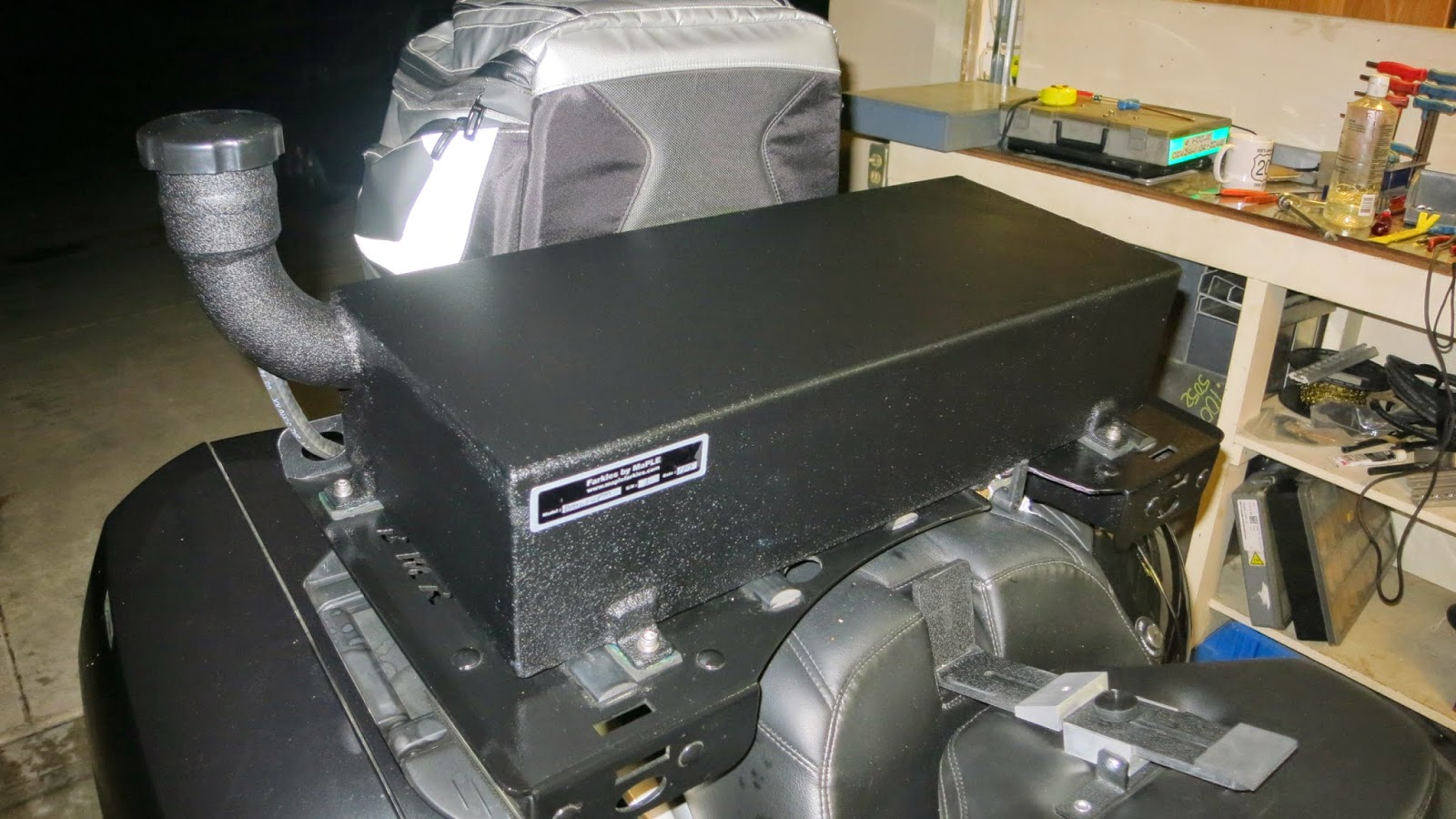
I recently had a client that wanted me to make an auxiliary tank to mount over the pillion seat on his K1600GT. He wanted to use his existing BMR shelf as the mounting.

The BMR shelf required a cutout for the shut off valve but otherwise it was a pretty straight forward job of building and mounting a tank. Stainless steel rivet nuts were installed in the BMR shelf and the tank bolted straight onto it.


Having access to the BMR shelf worked out perfectly for me. I was able to get the measurements I needed to make brackets and now have the solution to mounting a tank above the pillion seat using these stainless steel brackets I am now fabricating.


With these brackets I can fabricate and mount a tank that leaves the BMW top case intact. Alternatively, I can fabricate a longitudinal tank that extends from the rider's seat back over the tail rack. 

This means that there are now three options for the BMW models that use the lattice type luggage rack, these models include: the K1600GT and GTL, all flavors of the R1200, the R, RT, and ST, the K1200GT, the K1300GT, and all variants of the F800, the R, S and ST.


Friday, October 31, 2014

Roadside Breakdowns with the Triumph Trophy SE

I thought I'd be posting about my finish in the Texas 1836 rally but instead am posting about the latest failure on my 2013 Triumph Trophy SE. Well, I guess there is a finish status DNF (did not finish).

Here is the current state of my bike.


I'll post about the Big Tex Rally later (my pictures and files are stranded with my bike in Texas). For now I'll just review the bike failure and status.

The Trophy wasn't up to another multiday rally. On Friday, 10/17/2014 it started missing at Throckmorton, TX. After some discussions with the tech experts at two dealerships it was determined that nothing could be done at the roadside. The consensus was that it was an injector, an electrical problem, or a mechanical problem. Since I could detect no abnormal noised I was hopeful that it was not mechanical and opted to try to limp back to the dealer in Fort Worth. No joy, even though there were no mechanical noises I could hear, the top end gave up the ghost 20 miles later. 

Incredibly, my breakdown was just as I passed a highway patrolman who was engaged with another driver (he was writing a warning for being 15 over). When he finished he arranged for a local tow into Graham, TX so I wouldn't be stranded on the highway. He was a great guy and stuck around to keep me company. I had to pay this $250 out of pocket. I probably should have called my roadside assistance folks because I may not get this reimbursed. 

Since it was silly to go a closed dealership in Forth Worth, I stayed at a motel in Graham ($110) and arranged for my roadside assistance to tow me into the dealer on Saturday 10/18. This $550 tow was covered by the insurance with no out of pocket expense.

This was my daughter's last week in Austin, TX before she moved to Houston, so I was able to get her to come pick me up. We attended the rally finish banquet and then I went to Austin to help her with the move while I waited the time needed to get a cheap Spirit Airlines ticket from Houston to San Diego ($80).

The dealer said if all the stars align it might be repaired in 2 weeks. He tore it down and found a broken valve and a broken camshaft. He submitted a claim amounting to a major engine rebuild and we waited on Triumph to make a decision. On 10/30 the dealer called and said that Triumph was going to replace the engine.

Here is a what the piston looks like.


We are hopeful that the engine will come in and the bike will be ready by 11/15. Just to cover myself I'm making travel arrangements to arrive at the dealer on 11/22. 

I'll fly into Houston on Friday 11/21 via Spirit Airlines ($68) and then take a one way rental car from Houston to Ft Worth ($120).

By the time I get the bike home I will have been without it for over four weeks. Just one more lengthy repair added to the list of lengthy repairs I've already experienced.

These towing, travel, and lodging expenses are what makes a remote breakdown a dire situation. I'm lucky that I am retired and have no job commitments. A poor working stiff might lose a job over something like this.

Wednesday, October 1, 2014

Darkside on the Triumph Trophy

UPDATE 05/19/2020
My conclusions below were BEFORE I got the right tire. I subsequently ended up putting over 40,000 miles on the CT and had no regrets at all. I rode many rallies including the '15 Iron Butt Rally. The right tire for me was a Vredestein Sportrac3. It had a symmetrical tread pattern and nice rounded corners. I ran it at about 25PSI. Tire life was 18,000 to 20,000. I did have make my center stand a bit wider to clear the tire.


Darkside is the term used to describe putting a car tire (CT) on a motorcycle.

This has always had some appeal to me since a large part of my travels are on highways and the savings can be significant. Based on user experiences car tire life on a motorcycle will significantly exceed that of a motorcycle tire, with reports of mileage in excess of 25,000. Consider that on my K1200LT, the best mileage I could get was around 12,000 miles. Since I put over 160,000 miles on this bike I estimate that I purchased at least 15 tires at an average cost of $200 for a total of $3000. Could I have run car tires, I would have expected my tire cost to be less than $1000.

The controversy over running a CT on a bike is one of the most fervent discussions you can find on the motorcycle forums. The naysayers are convinced that putting a CT on a bike will result in immediate death and/or dismemberment of the rider. The proponents are equally rabid in their assertion that CTs are the best thing since sliced bread. I have researched both sides and have yet to find any hard science from either side.


On the naysayer side, there is a lengthy tome on the Goldwing forum  that is chock full of scientific data. But, as I gave it a critical read, I found that it was sorely lacking in "information". In my 30 years of experience as a technical writer, I have learned to recognize when a writer is cutting and pasting content with little to no understanding of said content. This is very apparent in this write up. There was nothing but opinion to substantiate the purported risks of putting a CT on a bike.

I was cautioned about the following but was not able to confirm any of the following:
  • crashes (regretfully, accident reports don't include any information as to the tire type)
  • insurance cancellation 
  • ticketing for not having the correct tire
  • voiding the warranty (this might be possible if your dealer is a jerk but nobody reported this happening)
On the proponent side, there is no scientific data that I could find, just anecdotal information about CT experiences. While the lack of scientific data appears damning, the experience can't be discounted. There have been thousands of riders, racking up millions of miles, over many decadewebsites, with no evidence of negative consequences, let alone dire consequences. The Darkside web is an excellent resource.

 I determined that the only way I would get an answer that would satisfy my curiosity would be to conduct my own trials.

When I acquired the Triumph Trophy SE, I began looking into putting a car tire on it. I acquired a spare rear wheel so I could easily swap things around. I'd had the bike for over a year before I finally got around to tackling this project. Following are my trials and observations.

First off I had to find a tire that would fit. The stock MC tire is a 190/60 on a 17 inch wheel. I needed to determine the optimal tire size and found a Tire Size Calculator to help me out. There was very little excess space between the stock tire and the swing arm but with careful measurements I determined that a 205 width tire would probably fit. Searching for a specific tire size is virtually impossible, I finally located a site that was immensely helpful, allow you to find tires using specific criteria Dutire.com.

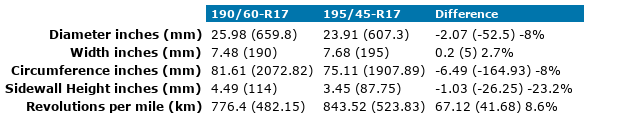
The 17" wheel proved to be extremely problematic. In the North American market there are very few tires options in this size wheel. This was the largest diameter tire I could find in a 205 width, which would change my speedometer and gearing as follows:
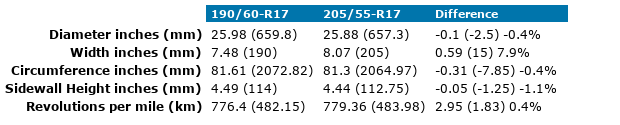

While I would have preferred a narrower tire the only tires available tire reduced the tire diameter so much I was concerned it would make it too hard to get onto the center stand. 

Finding a shop that will mount a CT on a motorcycle wheel was the next challenge. After stopping at several places I finally found a tire store that would take on the job AND they had used tires. This was great! I'd be able to verify that a 205/55 would fit since they would take a return. They didn't have a 205/55 so I took the next closest match,  a NEXEN 205/50. I was out the door with a good used tire, mounted and balanced for $30. I started out with 40 psi and, when I mentioned that it was pretty rough some fellow darksiders said that most folks ran low pressure. I dropped it to 32 psi which helped considerably.

I had seen videos of CTs on bikes but none had a good comparison. My first experiment was to shoot some video to see what was going on with this tire. Here are two videos, the first is a side by side comparison, the second is a side view under mid and high speed turns.


Following are my observations and opinions of putting a CT on this bike.
I have ridden it about 5000 miles over a wide variety of roads and road conditions.

Pro's

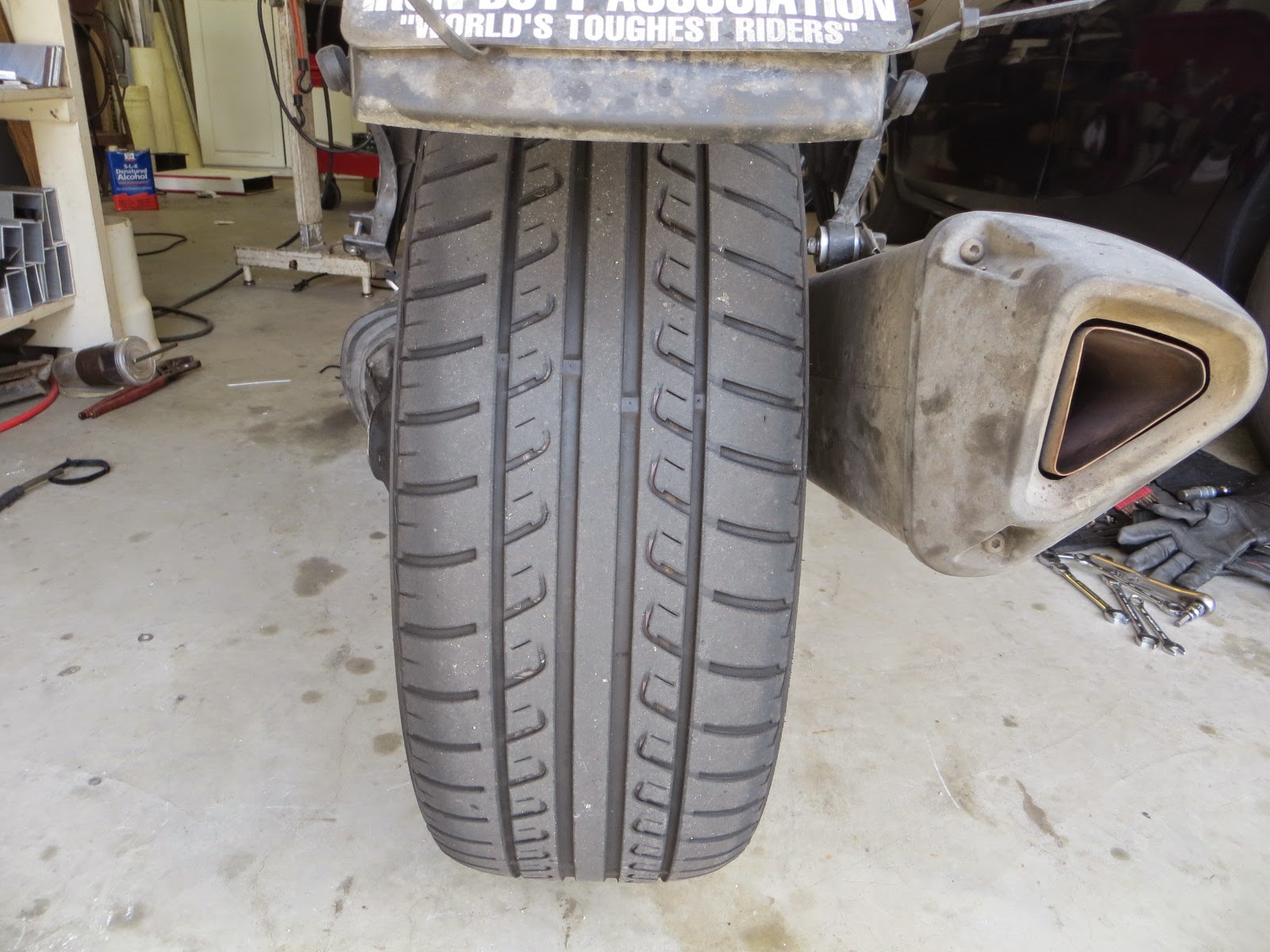
  • I put about 5000 miles on this tire and it showed very little wear. I didn't measure tread depth before I started but comparing my before and after photos it looks like 1 to 2/32s of wear. I can certainly see a new tire going in excess of 20,000 miles.
  • Once speeds exceed 30mph there is almost no difference in handling beyond the extra effort required for turns (see con's for lower speed behavior).
  • Long stretches of straight road are easier to handle.
  • Gravel/dirt roads are less stressful since the tire provides more stability.
  • Rain was less stressful since there is more tire on the road.
  • On a 2500 mile round trip consisting of mostly interstate and primary highways I was very pleased with the CT. I didn't have any problem navigating twisty mountain highways. (see cons for related opinion). Tire pressure on this trip was 32 PSI

Con's

  • The ride of the CT seems to be harsher (you can see this in the first video to some degree)
  • It is more difficult to initiate a turn. 
  • Once in the turn it requires more effort to maintain the turn since the tire is trying to go back to the flat.
  • Low speed maneuvers can be frightening since the tire wants to stay flat and continue going straight.
    At low speed any variation in the pavement can cause the bike to lean. As a radical example consider a pavement transition from low to high, if this is encountered at an angle the CT will tip to the low side of the angle. This can cause the bike to tip over if you are unprepared for this behavior. I almost lost is as I was backing up to a curb (California law on motorcycle parking). When the tire touched the curb, the bike lurched, and I barely was able to hold it up. 
  • At highway speeds it requires more effort to maintain a track and requires experience to compensate for this behavior. If you are drifting out of your desired track you must immediately apply enough force to regain the track or you might find yourself in the wrong lane (as I did on more than one occasion).
  • On a rally in northern California last month I rode over at 12 hour period I navigated 350 miles of extremely technical mountain highways. That 30mph average should give you an idea of the complexity of these roads. By the end of the day I absolutely hated the CT and regretted that I had decided to use it on the rally. The extra effort required for turning becomes quite tiresome and can certainly raise your fatigue level beyond what most long distance riders would want. Tire pressure had been raised on this rally to 35 PSI. 

Conclusion

 I think that the folks that love the CT on their bikes are very conservative riders and are likely on a cruiser or heavy touring bike. The CT is NOT a sport bike tire, the handling characteristics are quite a bit different and take some time to get used to. While I was able to maintain my spirited canyon carving riding style (dragging the footpegs), the additional effort required to initiate and maintain a turn pretty much spoils the fun we expect from a sport bike.

If I had to pick one or the other I'd stay with the motorcycle tire. Thankfully, I have two wheels so I can swap. 

If I can predict that the riding will be similar to my first trip I would definitely mount the CT. The performance under non-sport conditions is perfectly acceptable and the improved tire life and dirt/gravel handling more than offset the negatives.

BUT, if the road conditions and riding are anything like what I encountered on the rally, NO WAY! There were not nearly enough pro's to offset the fatigue level.
Bottom line is that if I didn't have the spare wheel the CT would be history.

Saturday, August 9, 2014

More farkles on the Trophy


After my long trip last month I realized that I was missing my powered hydration system and my food cooler. Both of these items made long trips much more enjoyable. I remade the mounting hardware for both items. The first iterations weren't as professional as I would have liked.

The water jug mount is a single loop of 1/8" x 1/2" stainless steel strap welded to vertical mounting bracket. This bracket is bolted to an aluminum block custom made which replaces the pillion foot peg.


I found a small pump that fit nicely under the fuel cell at the rear.
While this pump worked okay the flow rate was much less than the Harbor Freight utility pump plus it wasn't self priming. If I forgot to shut off the bite valve I had to suck some water to get it primed.

But it was small, fit the space so I was okay with it. I removed it this last week to see if I could located it below the water jug and the plastic outlet broke off. It is irreparable, $25 down the pooper. I just bought the HF pump. It will take some tweaking to get it to fit but I know the performance is excellent and you can't break stainless steel without trying.

Here is what it looks like now:


The food cooler bracket was remade to be a bit more professional. It also bolts to the passenger foot peg.


Gotta have my coffee available:
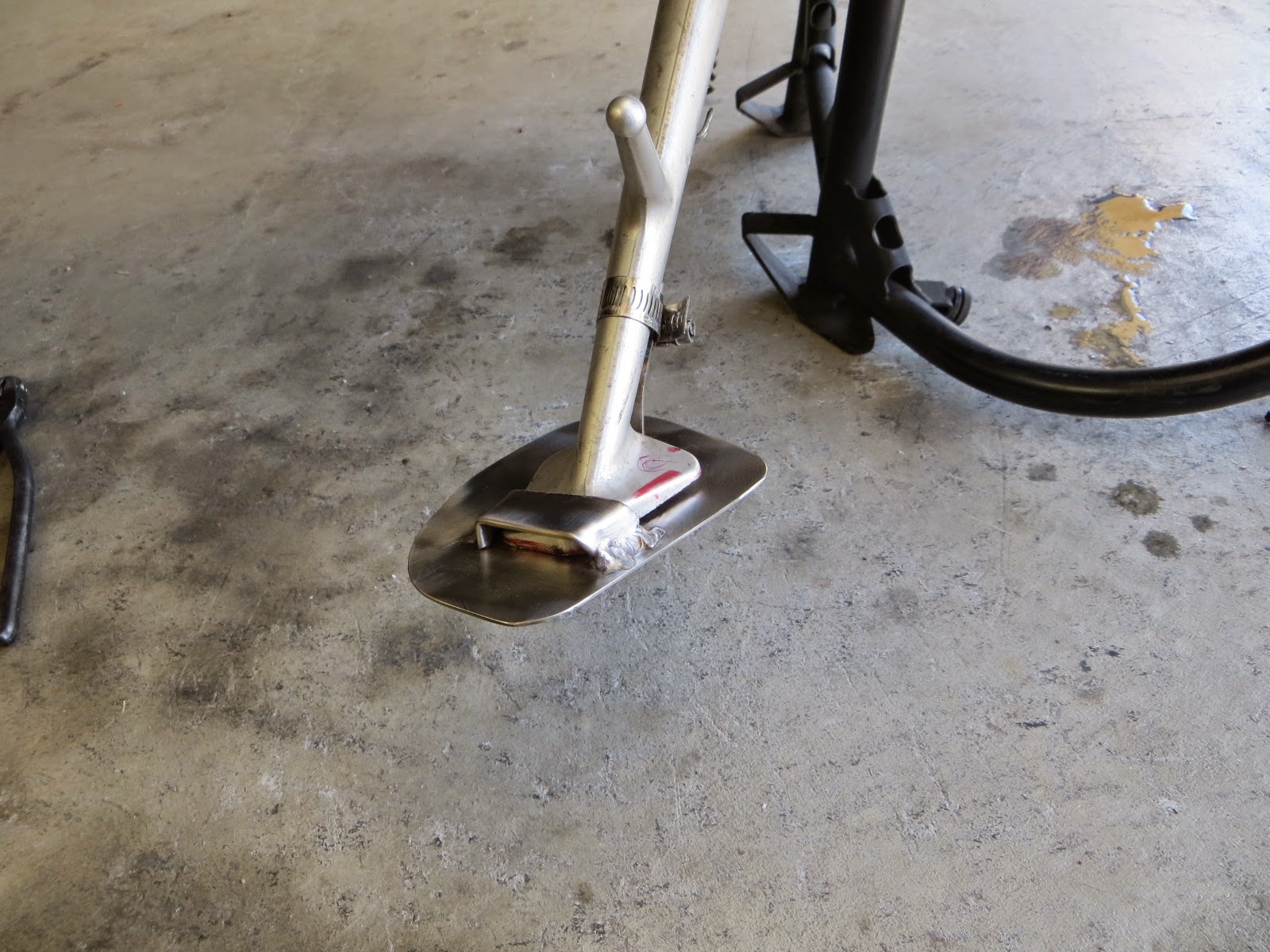
Based on a request for this farkle I made up a prototype "gravel foot" for the sidestand. I don't know if I can make these at a competitive price. It does work well.